Your container, from your door in Montreal
Once your belongings are in a container, nobody touches them until they reach the other side of the ocean — and then they are lifted, stacked, trucked and inspected. Everything that protects them on that journey is done before the doors are sealed, in Montreal. That is our part of an international move: choosing the right container, packing for weeks at sea, building crates, numbering every package and loading so that nothing can shift.
Which container
| Option | Approximate capacity | Typical use |
|---|---|---|
| Shared container (groupage) | billed by the cubic metre | a few pieces of furniture and boxes, a student move |
| 20-foot container | about 33 m³ / 1,170 cu ft | a one- or two-bedroom apartment |
| 40-foot container | about 67 m³ / 2,390 cu ft | a three- or four-bedroom house |
| 40-foot high cube | about 76 m³ / 2,700 cu ft | a large house with tall or bulky furniture |
These are starting points. The survey gives us your real volume, and the right choice is the smallest option that holds everything safely: empty space costs money and lets the load move. A household that fills a little more than a 20-foot container often goes in a 40-foot one with extra blocking, rather than splitting across two.
Live load or warehouse load
In a live load, the container arrives at your street on a chassis, we load it while the driver waits — usually a few hours — and it leaves for the port the same day. It is the fewest handlings your goods will get, but it needs space for a long truck. Many Montreal streets do not have it: plexes on narrow one-way streets, overhead wires, tight corners, condo towers with no truck access. Then we do a warehouse load — your goods come to a warehouse in our truck and are loaded into the container there. It adds one handling, and it removes the risk of a container that cannot park.
Shared containers
If you are shipping less than about a third of a 20-foot container, a shared container is usually the economical choice. Your goods are packed and crated as a unit, then consolidated with other shipments bound for the same region. The trade-off is time: a shared container waits until it is full, which can add a few weeks to the schedule.
Export packing
A household shipment at sea is exposed to humidity and temperature swings for weeks and handled more often than a truckload. We pack for that:
- double-wall cartons, and more paper and bubble wrap for dishes, glassware and décor;
- furniture in padded blankets and plastic, with corner protection;
- mattresses in sealed covers, clothes in wardrobe cartons;
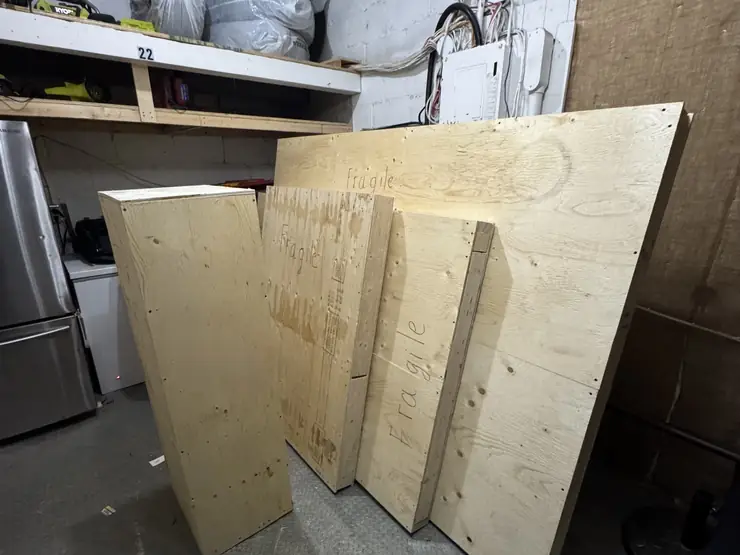
- custom wooden crates for art, mirrors, marble, glass tabletops, chandeliers and antiques.
Crates and pallets are built from heat-treated wood stamped to the ISPM 15 standard, which most countries require for wooden packaging. For collections and valuable pieces, see our custom packing and crating service.
The inventory
Every package gets a number, and the inventory says what is in each one. Customs at your destination will ask for it, the forwarder needs it for the shipping documents, and your insurer needs it if anything is lost or damaged. We write it in the format the destination agent asks for, and you sign the final version on loading day.
Loading so nothing moves
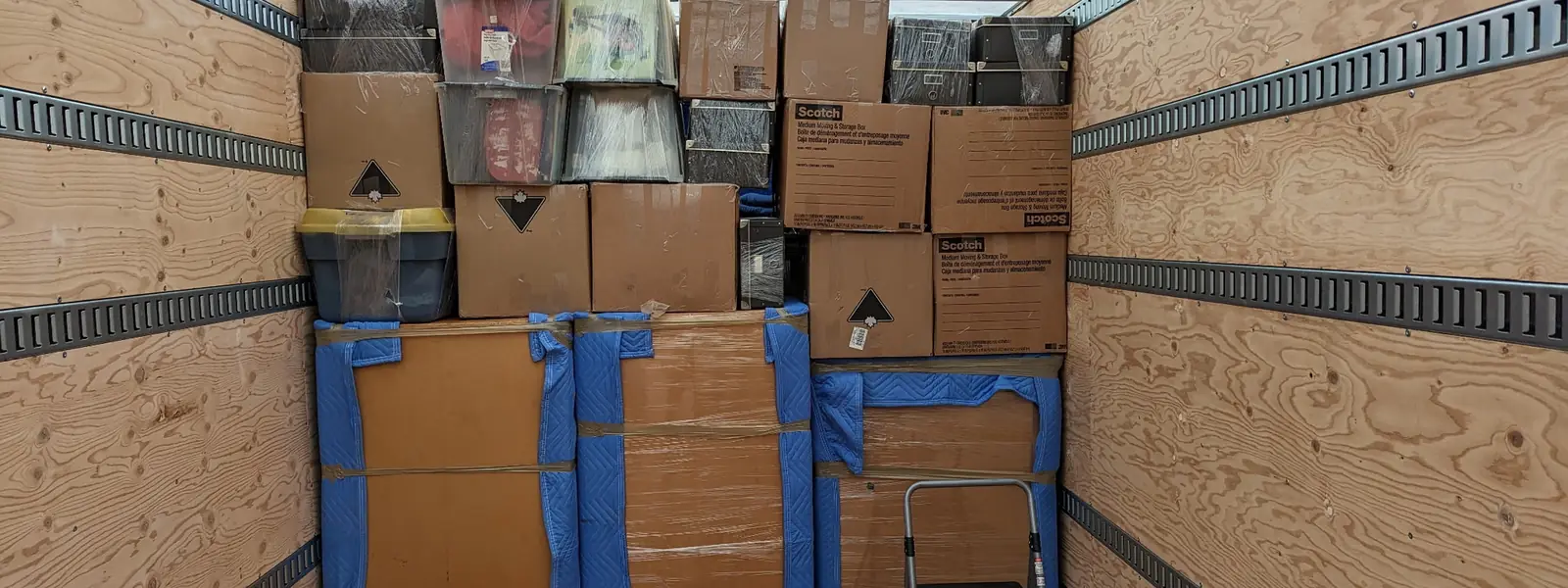
A container that is packed loosely will shift on the first rough day at sea. We load heavy pieces low and toward the front, build the load in tight tiers, fill gaps with soft goods and blocking, and brace the last row against the doors. Then the container is sealed, and the seal number goes on the paperwork.
Arriving in Montreal by container
It works in reverse too. When your container arrives in Montreal from abroad, we collect it from the port or the forwarder’s warehouse — or meet it at your door — unload, unpack, reassemble the furniture and take away every piece of packing material.