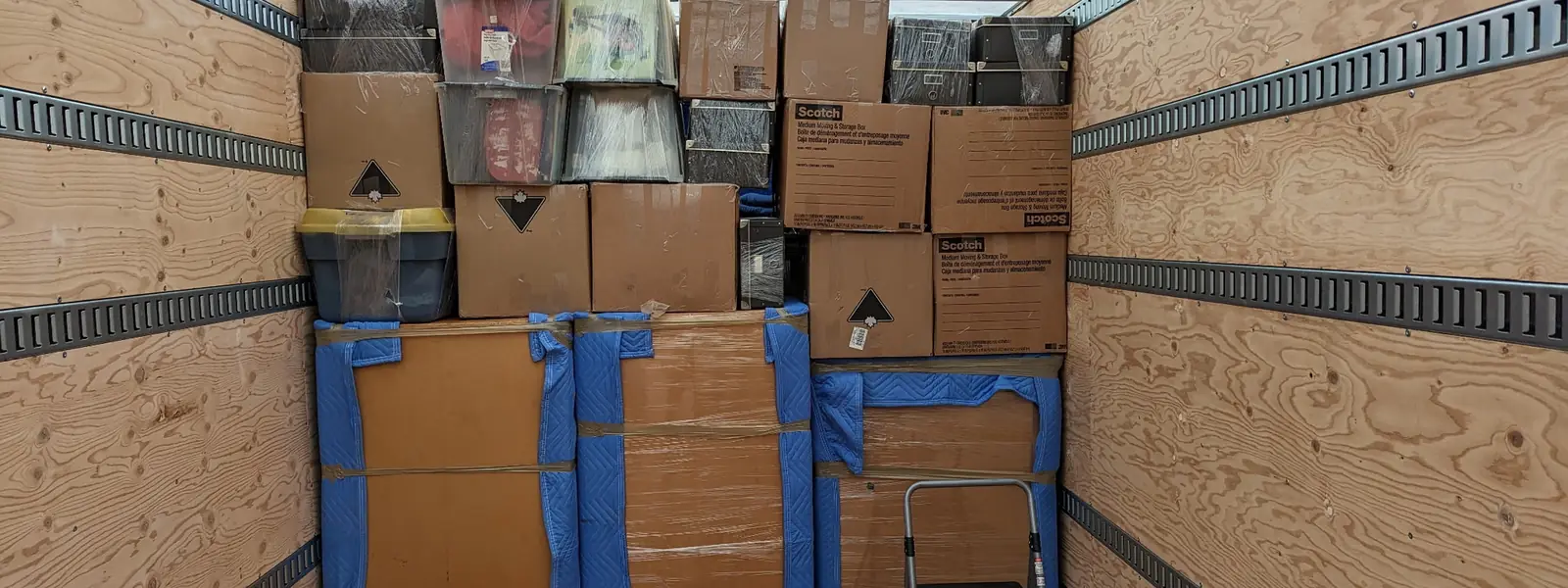
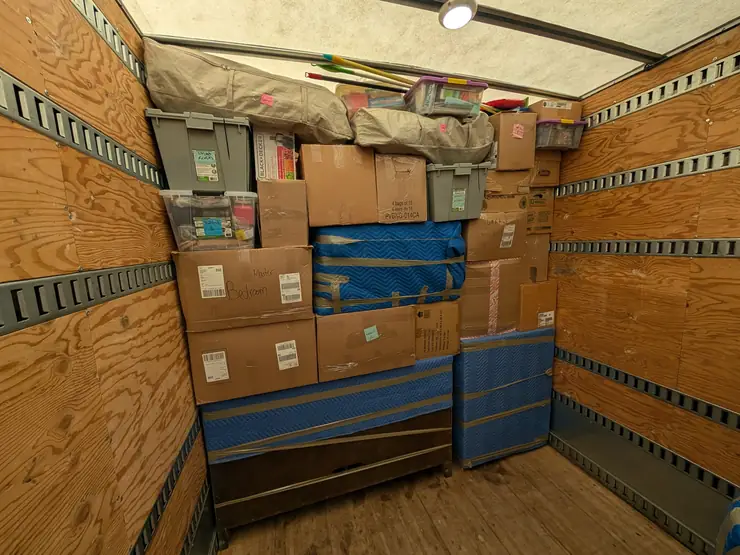
Office moving in Montreal, planned around your working week
An office move is judged on one thing: whether your team can sit down and work on the first morning in the new space. Everything we do — the site visit, the labelling, the timing, the sequence of the move — is aimed at that moment. The rest of the business should notice as little as possible.
We move offices of every size across Greater Montreal: two-person professional offices in Verdun, startups in the Mile End and Griffintown, law and accounting firms downtown, clinics on the South Shore and regional offices in Laval and the West Island. The crew is our own, the quote is in writing after a site visit, and one coordinator is your contact from the first call to the last walkthrough.
A typical office move, step by step
Two to six weeks before: the site visit
Someone from our team visits your current office, and the new one if it is accessible. We count workstations, private offices, meeting rooms, filing cabinets and storage; we check freight elevators, loading docks and parking at both buildings; and we note anything that needs special handling — safes, server racks, large printers, artwork, plants. Within two business days you receive a written plan and a quote.
Two weeks before: the floor plan
You send us the floor plan of the new space with each desk and room numbered. Every person, room and piece of shared furniture gets a code. We deliver labels, and in most cases plastic crates or boxes for packing. The codes are what make the rest of the move fast: at the new office, the crew does not need to ask where anything goes.
The last working day: packing
Staff pack their personal items and desk contents into crates, label them, and label their chair, monitor and computer. Our crew packs shared areas — the kitchen, the supply room, files and archives — and anything fragile. Your IT provider disconnects and prepares equipment according to their own plan.
The move: evening, night or weekend
The crew arrives at the agreed time, protects floors, walls and elevators in both buildings, and disassembles workstations where needed. Loading follows the new floor plan so that the truck is unloaded in the order the new space is set up. For larger offices we run two or three trucks in rotation so that one is loading while another is unloading.
The first morning: setup and walkthrough
Furniture is reassembled and placed, crates are at the right desks, computers and monitors are on the right workstations, and your IT team can reconnect. We walk through the space with you, fix anything out of place, and collect the empty crates on a date that suits you.
What we move in an office
- Workstations, desks, returns, pedestals and panel systems, disassembled and reinstalled
- Office chairs, boardroom tables, lounge and reception furniture
- Filing cabinets and lateral files — moved full or empty depending on their construction and weight
- Archives and records, packed in numbered boxes with an index so files can be found on day one
- Computers, monitors, printers and phones, packed and placed at the labelled desks
- Server racks and network equipment, prepared by your IT provider and moved as a priority load
- Kitchen appliances, plants, artwork and décor
- Safes and heavy equipment, quoted as specialty items with the right equipment
When the furniture changes too
Many office moves come with new furniture, a new layout or furniture that is not coming along. The furniture side — disassembling and reinstalling workstations, reconfiguring systems furniture, assembling what your supplier delivers, removing what you are not keeping — is its own job, described on our office furniture page. On moving night it runs as part of the same plan.
Internal office moves
Not every office move leaves the building. Moving departments between floors, rearranging a floor after a renovation or shifting teams to make room for new hires is an internal relocation, and it follows the same method at a smaller scale: a plan, labels, an evening or weekend and a walkthrough. Internal moves are often finished inside a single shift.
Pricing an office move
Office moves are priced fixed or hourly, depending on the project. A larger relocation with a clear scope is usually quoted as one project price that includes the crew, the trucks, the crates or boxes, labels, packing of shared areas, disassembly and reassembly, and the number of shifts in the plan. A small office or an internal move between floors is often simpler and cheaper by the hour, with a realistic range of hours in the estimate. Evening, overnight and weekend work carry no premium either way. If you add or remove scope — another floor, a storage unit, furniture disposal — the quote is updated in writing before the move.
What makes an office move cost more is mostly access and time: a building with one small freight elevator and a two-hour window will need more crew for less time; a ground-floor space with a dock and a whole weekend will need fewer. The site visit is where we find the balance that costs you least.
Working with your building and your IT provider
Commercial buildings have rules: moving hours, elevator bookings, floor protection, security escorts and certificates of insurance naming the landlord and management company. We handle all of that with both buildings and send certificates directly to the property managers.
We also coordinate closely with your IT team or managed-service provider. They disconnect, back up and reconnect; we pack, move and place. Agreeing the order in advance — which equipment leaves first, which room is set up first — is what gets your network running early on the first morning.
Why offices choose Simplex
A predictable plan, a written quote, no premium for after-hours work, and a crew that does not change halfway through the job because it was subcontracted. If you are also relocating employees to or from Montreal, see our corporate relocation service; if the move includes a period in storage, see storage.
Office move timeline
| When | Task | Who |
|---|---|---|
| 8–12 weeks before | Confirm the new space handover date, book the site visit | You and us |
| 6 weeks before | Approve the plan and price; book elevators and docks at both buildings | Us, with building managers |
| 4 weeks before | Floor plan numbered; IT plan agreed; furniture decisions made | You, IT provider, us |
| 2 weeks before | Crates and labels delivered; staff briefing | Us and your office manager |
| 1 week before | Archives and storage rooms packed | Our crew |
| Last working day | Staff pack desks; IT disconnects | Your team and IT |
| Moving night or weekend | Move, reassembly, setup | Our crew |
| First morning | Walkthrough, adjustments, IT reconnection | You, IT, us |
Keeping the business running during the move
For most businesses, the goal is zero downtime: close on Friday, open on Monday. That depends on a few decisions made early. Phones and internet should be ordered at the new address well in advance; carriers often need several weeks. Critical equipment — the server, the main printer, the reception phone — should be the first thing moved and set up. Customer-facing areas such as a reception or a showroom should be set up first so they look finished on day one, even if back offices are still being arranged. And a small team from your side should be at the new office on the first morning to answer questions and flag anything out of place.
Small offices
Not every office move is a weekend project. A professional office of two to ten people — a law practice, an accounting firm, a clinic — often moves in a single evening with three or four movers and one truck. The method is the same: a short site visit, labels to a floor plan, crates for the desks, and a walkthrough at the end. Small offices often combine the move with new furniture; we assemble and place it the same night.
After the move
We collect the crates on a date that suits you, remove packing materials, and can return to the old space to take out any furniture left for disposal or donation. If some furniture or archives go to storage, we keep an inventory so anything can be retrieved later.
IT equipment: what we do and what your IT provider does
| Task | Us | Your IT provider |
|---|---|---|
| Back up data and shut down servers | ✓ | |
| Disconnect network, phones and servers | ✓ | |
| Pack computers, monitors, printers and peripherals | ✓ | |
| Move server racks and network equipment | ✓ | advises |
| Place equipment at the labelled desks | ✓ | |
| Reconnect network, phones and servers | ✓ | |
| Test and support staff on the first morning | ✓ |
Agreeing this split in advance is what gets the office running on the first morning. We share the move schedule with your IT provider so they know when equipment leaves the old office and when it arrives at the new one, and we move critical equipment first so they can start early.
Moving an office with sensitive documents
Law firms, clinics, accounting offices and financial businesses move confidential records. Files travel in sealed, numbered boxes, with a list that follows them from the old office to the new one. Nobody on our crew opens a box. If your policies require it, a member of your staff can supervise the loading and unloading of records.
Weekend moves and building staff
Weekend and overnight moves need the building on board. Many office towers require a security guard or building staff to be present during after-hours moves, sometimes at the tenant’s cost, and some limit the hours when the freight elevator can be used. We confirm those requirements during the site visit and put them in the plan, so nobody is surprised on Friday night.