Moving from Quebec to another province
Whether you are moving from Montreal to Ottawa for a new job, to Toronto to be closer to family, to Halifax for a quieter life or to Calgary or Vancouver for a fresh start, an interprovincial move has three things in common: a long distance, a lot of planning and a price that should not change once the truck leaves. Every interprovincial move we do is quoted as one fixed price, in writing, based on your inventory and the distance, with a delivery window you know before loading.
We move households and businesses from Montreal to every province, and from every province to Montreal.
Where we move from Montreal
| Destination | Distance by road | Price band (1 bedroom, dedicated) | Typical transit |
|---|---|---|---|
| Ottawa, ON | about 200 km | from $1,150 | same or next day |
| Kingston, ON | about 290 km | from $1,150 | same or next day |
| Toronto, ON | about 540 km | from $1,450 | 1–2 days |
| Fredericton, NB | about 780 km | from $2,350 | 2 days |
| Moncton, NB | about 1,000 km | from $2,350 | 2 days |
| Halifax, NS | about 1,250 km | from $2,350 | 2–3 days |
| Charlottetown, PE | about 1,170 km | from $2,350 | 2–3 days |
| Winnipeg, MB | about 2,270 km | from $2,950 | 3–5 days |
| St. John’s, NL | about 2,400 km incl. ferry | from $2,950 | 4–6 days |
| Regina, SK | about 2,850 km | from $2,950 | 4–6 days |
| Calgary, AB | about 3,740 km | from $4,400 | 5–7 days |
| Edmonton, AB | about 3,700 km | from $4,400 | 5–7 days |
| Vancouver, BC | about 4,540 km | from $4,400 | 6–8 days |
Distances are approximate. Transit times are for a dedicated truck from loading day; shared trailers deliver inside a longer window agreed in writing and cost roughly 30% less. Prices are starting points for a one-bedroom apartment; your fixed quote is based on your inventory.
Quebec to Ontario
Ontario is the most common interprovincial destination from Montreal. Ottawa is close enough that most moves are loaded in the morning and delivered the same evening. Toronto, along Highway 401, is a one- or two-day move; condo buildings downtown usually require an elevator booking and a certificate of insurance, and we arrange both. We also move regularly to Kingston, Cornwall, Brockville, the Greater Toronto Area, Hamilton, Waterloo Region and London.
Quebec to the Maritimes
Moves to New Brunswick, Nova Scotia and Prince Edward Island follow the Trans-Canada Highway through the Lower St. Lawrence and the Saint John River valley. Moncton and Fredericton are typically two-day deliveries; Halifax and Charlottetown, two to three days. The Confederation Bridge toll for Prince Edward Island is included in the price.
Quebec to Newfoundland and Labrador
A move to St. John’s, Corner Brook or Gander includes the Marine Atlantic ferry crossing from North Sydney, Nova Scotia to Port aux Basques or Argentia. The crossing is part of the fixed price. Delivery windows take ferry schedules and weather into account, and we keep you informed if a sailing is delayed.
Quebec to the Prairies
Moves to Winnipeg, Regina and Saskatoon cross northern Ontario on the Trans-Canada. They are long routes, and many of our customers choose a shared trailer to save on cost when their dates allow.
Quebec to Alberta and British Columbia
Calgary, Edmonton, Vancouver, Kelowna and Victoria are our longest domestic routes. A dedicated truck is the fastest and most predictable option; a shared trailer lowers the price significantly on routes this long. For Vancouver Island, the BC Ferries crossing is included in the price.
Dedicated or shared: choosing the right service
A dedicated truck carries only your belongings, loads on your date and drives directly to you. Choose it when you need your furniture on a specific day or when you are moving a large home.
A shared trailer carries two or three households heading in the same direction. Your belongings are wrapped, loaded and strapped separately, with their own inventory. You save roughly 30%, and in exchange you accept a delivery window of several days. It suits smaller moves, flexible dates and anyone with somewhere to stay while the truck is on the road.
For a few items — a bedroom set, some boxes, a piece of furniture from a family home — ask about a small shipment on a shared route.
Paperwork when you move to another province
Your belongings move freely between provinces; there is no customs process inside Canada. What changes is your own paperwork. Each province sets its own rules and deadlines for exchanging a driver’s licence, registering a vehicle and joining its health insurance plan, so check the receiving province’s requirements as soon as you know your moving date. Before you leave Quebec, notify the RAMQ, the SAAQ and Revenu Québec, set up mail forwarding with Canada Post, and close or transfer your utilities.
How to prepare for an interprovincial move
- Start early. Book four to eight weeks ahead in summer. The fixed price depends on your inventory, so the earlier you do the survey, the earlier you can plan.
- Reduce what you move. On a long route you pay for volume. Selling or donating furniture you will not use can lower the price more than any discount.
- Pack for the distance. Boxes on a long route must be full, taped and stackable. Dishes and glassware need proper packing; our packing services can take care of it.
- Plan your own trip. Arrive before the truck, or have someone at the new home to receive it.
- Keep essentials with you. Documents, medication, jewellery, laptops and a few days of clothing should travel with you, not on the truck.
Moving employees between provinces
If your employer is paying for the move, we can bill the company directly under its relocation policy. See corporate relocation for how we work with HR teams and relocation companies.
Moving to Montreal from another province
The same routes run in reverse. A family leaving Calgary for Montreal, or a student coming from Halifax, gets the same fixed price and delivery window; at our end, the service area pages explain the local details newcomers do not expect — borough parking permits, outdoor staircases and a province where most leases end on June 30.
Moving from Montreal to Toronto: what to expect
Toronto is the most common interprovincial move from Montreal. The route along Highway 401 is about 540 km, and with a dedicated truck most moves are loaded one day and delivered the next. Toronto condo towers usually require an elevator reservation, a certificate of insurance and a specific moving time; houses in older neighbourhoods may have narrow streets and limited parking. We confirm the building rules at the Toronto end before loading so the delivery day runs smoothly. The same planning applies to Ottawa, where federal-government transfers are common, and to the Greater Toronto Area, Hamilton and Waterloo Region.
Moving from Montreal to Calgary, Edmonton or Vancouver
Western Canada moves are the longest domestic routes: 3,700 km to Calgary or Edmonton, 4,500 km to Vancouver. On routes this long, the choice between a dedicated truck and a shared trailer makes the biggest difference to price. A dedicated truck delivers in about five to eight days; a shared trailer takes longer but costs significantly less. Many customers moving west choose a shared trailer and plan a week or two in a furnished rental on arrival.
Moving from Montreal to the Maritimes and Newfoundland
Moves east to New Brunswick, Nova Scotia and Prince Edward Island take two to three days with a dedicated truck. Newfoundland adds the ferry crossing from North Sydney, and in winter the crossing can be delayed by weather. We build that into the delivery window and keep you informed.
A long-distance moving checklist
| When | What to do |
|---|---|
| 8 weeks before | Request a video survey; decide dedicated or shared |
| 6 weeks before | Confirm the fixed quote and dates; start sorting and selling |
| 4 weeks before | Notify your employer, schools and doctors; gather records |
| 2 weeks before | Pack non-essentials; arrange utilities at the new address |
| 1 week before | Confirm the loading day; notify the RAMQ, SAAQ and Revenu Québec |
| Loading day | Walk through the inventory; keep valuables and documents with you |
| Arrival | Be at the new home (or send someone) for the delivery window |
Protecting furniture on a long route
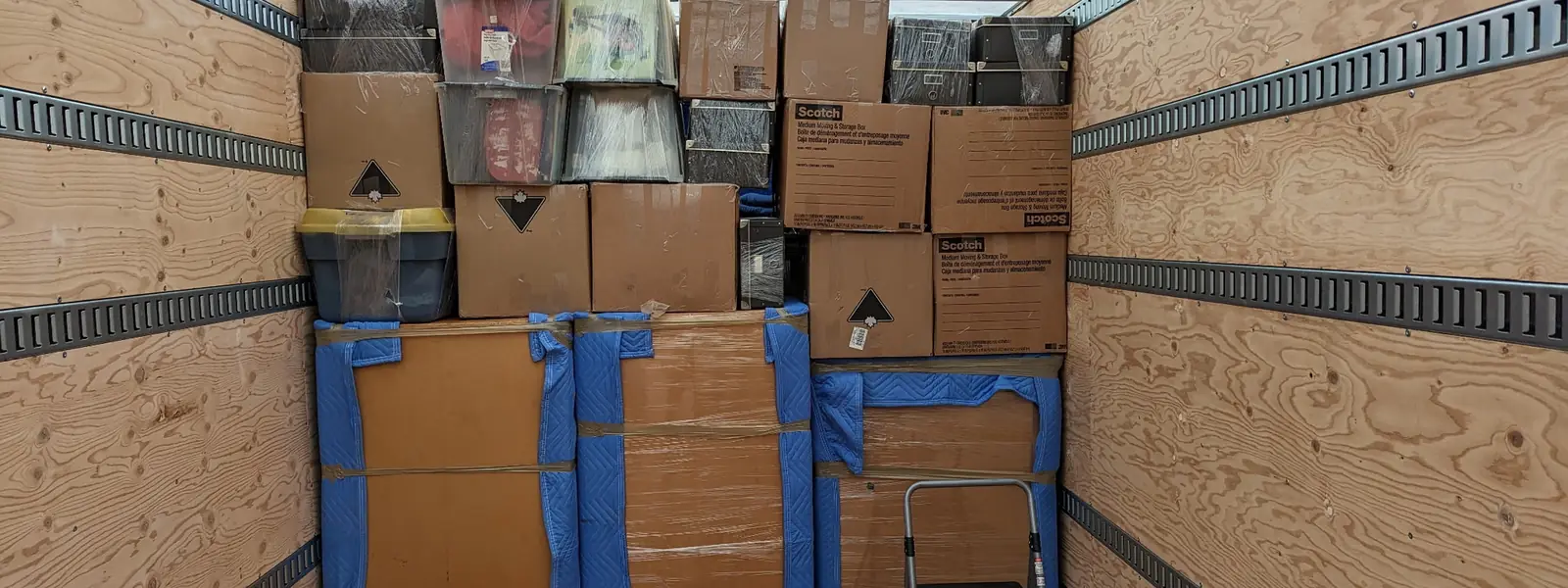
Every piece of furniture is blanket-wrapped and stretch-wrapped, beds and tables are disassembled, mattresses go in covers and the truck is loaded in tiers with heavy items low and forward. Everything is on a numbered inventory checked at loading and at delivery. For fragile items and kitchens, our packing services use stronger materials for long distances.
How to lower the cost of an interprovincial move
On a long route, a few decisions change the price more than anything else:
- Move less. Price follows volume. Selling or donating furniture you do not love can lower the price by hundreds of dollars — often more than it is worth.
- Choose a shared trailer if you can accept a delivery window. It costs roughly 30% less than a dedicated truck.
- Be flexible on dates. Avoiding the end of June and the busiest summer weeks gives you more choice, and shared trailers fill faster in your direction outside the peak.
- Pack yourself, but pack well. Self-packing saves labour; weak boxes and half-empty cartons cost more in damage than they save.
- Make access easy. A truck at the door and a booked elevator at both ends shorten loading and delivery.
Pets and plants
Pets travel with you, not in the moving truck. Plan their trip — carrier, food, water, rest stops and a pet-friendly place to stay on longer routes — and bring their records. Houseplants generally cannot travel in a closed truck for several days: the heat, cold and darkness will kill most of them. Give them to friends, or take a few favourites in your car.