Montreal to Toronto: one highway, two very different cities
The road is simple. Autoroute 20 takes you west out of the island, becomes Highway 401 at the Ontario line, and the 401 runs almost straight to Toronto — 541 km, about five and a half hours in a car, a little more in a loaded truck. What makes the move work is not the drive. It is what happens at each end: a Montreal walk-up or plex on the way out, and very often a Toronto condo tower with its own rules on the way in.
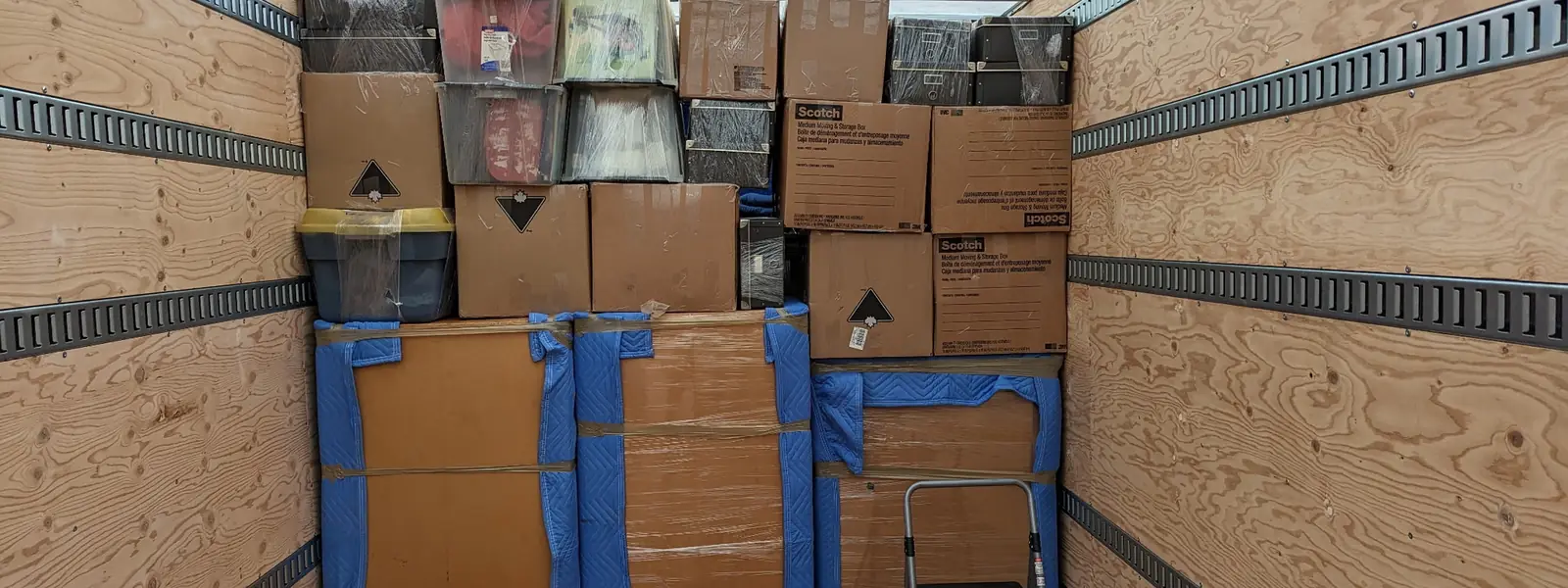
We load in Montreal with our own crew, drive the 401, and deliver and reassemble in Toronto. The price is fixed in writing before we load, based on what you are moving, and it does not change on the road.
When your new address is a condo
Most of our planning for a Toronto delivery goes into the building. Condo corporations in Toronto usually ask for three things before a move-in: an elevator booking — often a service elevator and a fixed time slot — a certificate of insurance from the mover naming the corporation, and a deposit held by the building. Some limit moves to weekdays or to certain hours, and some reserve the loading dock separately from the elevator.
The order matters. Book the elevator first, then confirm the move date with us, because the building’s slot is the one thing we cannot move. Send us the property manager’s contact and we send the certificate directly. If your Montreal building also has an elevator booking, we plan the loading around that slot the same way.
Where in the Greater Toronto Area
“Toronto” can mean a condo on the waterfront, a semi-detached house in Leslieville, a townhouse in Markham or a detached house in Oakville. The delivery changes with it:
- Downtown and the waterfront — towers, loading docks, tight streets and parking rules that make a building’s own dock the only practical option.
- Older neighbourhoods — The Annex, Leslieville, the Junction — narrow houses, steep staircases and street parking, closer to a Montreal plex than to a tower.
- The suburbs — Mississauga, Brampton, Vaughan, Markham, Oakville — houses with driveways, larger volumes, and easier access for the truck.
Tell us the address and the type of building during the survey; it changes the crew and the timing more than the distance does.
Dedicated truck or shared trailer
With a dedicated truck, your belongings are the only shipment on board and arrive on the date you choose — usually the next day, sometimes the same evening for a small apartment. With a shared trailer, your shipment travels with others heading along the 401; it costs roughly 30% less and arrives within a window of about three to seven days. If your Toronto lease starts on a fixed date and you have nowhere to wait, dedicated is worth it. If you can stay with family for a few days, shared saves money.
Timing the move
The busiest stretch for any Montreal mover is the week around July 1, when a large share of Quebec leases end. Moving to Toronto a week earlier or later makes every date easier to get. Summer is busier than spring and fall in general; winter moves on the 401 are routine, with the usual allowance for snow on the day.
Settling in Ontario
A move between provinces has no customs, but a few things change. Your health coverage moves from the RAMQ to OHIP, your driver’s licence and vehicle registration move to Ontario, and your address changes with the Canada Revenue Agency and your bank. Keep your moving receipts: if you move for work or study, part of the cost may be deductible — ask your tax adviser.
For moves to the rest of Ontario, the Maritimes and the West, see interprovincial moving. For how long-distance pricing works in general, see long-distance moving.