When a box is not enough
Most of what you own travels safely in a box or a moving blanket. Some things do not. A marble tabletop cracks if it flexes. A large painting can be punctured through its canvas. A chandelier has hundreds of parts that must not touch each other. A piece of equipment has a weight that crushes any carton. For these items, the right protection is a wooden crate built around the piece.
Our custom packing and crating service designs and builds crates to measure, packs fragile and valuable items with the right materials, and palletizes goods for shipping and storage. We crate for local moves, long-distance and cross-border moves, international shipments and storage.
What we crate
- Artwork: paintings, framed works, sculpture and mixed-media pieces.
- Stone and glass: marble, granite and quartz tabletops, glass table tops, mirrors and glass shelves.
- Lighting: chandeliers and large fixtures, with crystals and arms packed separately.
- Antiques and heirlooms: cabinets, clocks, instruments and collections.
- Electronics and equipment: large screens, audio equipment, medical, laboratory and office equipment.
- Machinery and tools: workshop machines and industrial parts, on skids.
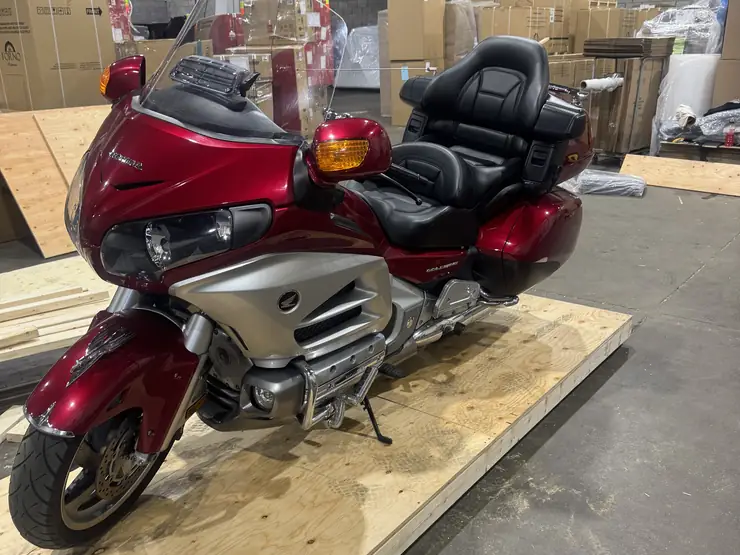
- Motorcycles and small vehicles for shipping.
Types of crates
| Crate type | Used for |
|---|---|
| Standard wooden crate | heavy or fragile items moving locally or long distance |
| Foam-lined crate | art, glass, stone and electronics that need cushioning |
| Travel frame | paintings held by their frame or stretcher, no contact with the surface |
| Slat crate | large, sturdy items that need structure more than enclosure |
| Skid or pallet base | machinery, equipment and palletized goods moved by forklift |
| Export crate (ISPM 15) | anything crossing a border, built from heat-treated, stamped wood |
How a crate is built
- Measure and assess. We measure the piece, estimate its weight, note fragile points and where it is going.
- Design. We choose the crate type, the interior support and the cushioning. A painting is held by its frame; a tabletop travels on edge supported along its length; a sculpture is blocked at its strongest points.
- Build. The crate is built to fit, with enough clearance for padding but not enough for the piece to move.
- Pack. The item is wrapped — glassine, foam, corner protection or padding as appropriate — and secured inside.
- Mark. The crate is marked with orientation arrows, handling instructions and a reference number for the inventory.
Export crating and ISPM 15
Wood used for crates and pallets in international shipping must meet the ISPM 15 standard: it is heat-treated to eliminate pests and stamped with an official mark. Most countries enforce it, and untreated wooden packaging can be refused, treated at your cost or destroyed on arrival. Every crate and pallet we build for export uses ISPM 15-compliant wood. See international moving for how export shipments work.
Palletizing
For shared trailers, containers, freight and storage, boxes and equipment are stacked on pallets, strapped and stretch-wrapped into a single unit that can be moved by forklift. Palletized goods are handled less, stack better and are easier to count. We palletize household shipments for long-distance and international moves, and business goods for commercial relocations and storage.
Specialized packing without a crate
Not everything needs a full crate. Framed art can be boarded between rigid sheets; mirrors travel in mirror cartons; electronics go back in their original boxes; collections are wrapped piece by piece in acid-free tissue and cushioned in small cartons. We recommend the level of protection each item needs — a crate when it is justified, and not when it is not.
Crating for moves, storage and shipping
- Local moves: crates for the few items that need them, packed the day before or on the morning of the move.
- Long-distance moves: crates protect fragile pieces over days of vibration and handling.
- International shipping: ISPM 15 crates and pallets, packed to export standard.
- Storage: crated items are protected from dust and pressure for months.
- Single items: a painting to a gallery, a tabletop to a new home, equipment to a buyer.
Pricing
Each crate is quoted after measuring, based on its size, construction and interior packing. When several items are crated for the same move, they are quoted together, and crating can be added to any moving quote. You can keep the crates afterwards — they are useful for storage and future moves.
Why custom crating matters
The cost of a crate is small compared with the cost of replacing a marble table, restoring a painting or repairing equipment. Crates also make items easier to handle: they can be moved by dolly or forklift, stacked when designed for it, and they carry clear instructions for everyone who touches them along the way. For household packing of boxes, dishes and closets, see our packing services; for art and antiques specifically, see fine art and antique moving.
Crates on the move day
Crated items are handled differently on moving day. They are loaded separately from household goods, secured upright to the truck wall with their orientation arrows respected, and never used as a base for other items. At the destination, they are carried to the room where they will be unpacked. For long-distance and international moves, each crate is on the inventory with its reference number and contents. If a crate has to be opened for a customs inspection, the markings and the inventory tell the officer how to open and reclose it without damaging what is inside.
Crating by item: what we recommend
| Item | Recommended protection |
|---|---|
| Framed painting, standard size | boarded pack or picture carton; crate for long distance |
| Large or valuable painting | foam-lined crate or travel frame |
| Unframed canvas | travel frame, nothing touching the paint |
| Sculpture | custom crate with foam blocking |
| Marble, granite or quartz top | crate on edge, supported along its length |
| Glass tabletop or shelves | padded crate or glass carton, on edge |
| Large mirror | mirror carton; crate if oversized or antique |
| Chandelier | crate for the frame, separate boxes for crystals |
| Antique cabinet with glass | glass removed and crated; cabinet blanket-wrapped |
| Large TV or monitor | original box or foam-lined crate |
| Workshop machine | skid base, strapped and covered or fully crated |
Chandeliers: a special case
Chandeliers combine fragility, weight and many loose parts. The fixture should be taken down by a qualified electrician. The crystals, arms and drops are removed, wrapped individually and packed in labelled boxes, with photographs of how they were attached. The frame travels in its own crate, suspended or padded so nothing touches the bottom. At the destination, the electrician reinstalls the frame and the crystals are reattached from the photographs.
Stone and glass tabletops
Stone tops are heavy, and they crack when they bend. A marble top laid flat on a truck floor can break from its own weight when the truck goes over a bump. Stone and glass tops are always removed from their bases where possible and moved on their edge, in a crate or on an A-frame, supported along their full length. The base is wrapped and moved separately.
Crates for storage
Crated items store well: the crate protects against dust, pressure from other stored items and accidental knocks. For long-term storage, we avoid sealing items in plastic that can trap moisture, and we mark each crate clearly so it can be found and retrieved without opening others.
Reusing crates
A well-built crate can be used more than once. If you keep yours, store it flat or assembled in a dry place, with its packing materials inside and the markings intact. For export, check that reused wood still carries a valid ISPM 15 stamp.
Crating for businesses
Businesses use custom crating for equipment, displays, prototypes, exhibition materials and inventory that ships to clients, trade shows or other sites. We build to your dimensions, can produce several identical crates, and palletize them for freight.
Crating for galleries, designers and collectors
Galleries, interior designers and collectors often need crating without a move: a work going to an exhibition or a buyer, a piece of furniture shipping to a client in another city, a collection going into storage. We crate single pieces and small groups on request, deliver the crated items locally or prepare them for a freight carrier, and can build matching crates for works that travel together. For household moves that include art and antiques, crating is added to the same quote.
How long crating takes
Most crates are built in our workshop from your measurements and brought to your home ready to pack, or built on site when the piece cannot travel unprotected even to our workshop. A few standard crates can usually be ready within days; a large number of crates or complex pieces need more time. Tell us your moving or shipping date when you ask for a quote so we can schedule the build.
Materials we use
- Plywood and solid lumber, heat-treated and stamped for export
- Foam in several densities, cut to the piece
- Glassine and acid-free tissue for artwork and finished surfaces
- Corner protectors, edge guards and padding
- Moisture-resistant liners for long storage or ocean transport
- Screws rather than nails where a crate will be opened and reused
Opening a crate safely
Crates are built to be opened without damaging what is inside: screws rather than nails on at least one panel, and the opening side marked. Open crates in the room where the item will stay, remove the marked panel, and lift the item out by its strongest points. If in doubt, let the crew unpack it — on delivery with us, unpacking crated items is part of the job.